

The :only-of-type Selector is used to select the elements, who are the only child of their parent of the same type.
Let us simplify with the below example.
<html>
  	<head>
    	<title> My First Programme </title>
  	</head>

  	<body>
    	<h1> JQuery </h1>

    	<div class = "newClass1">
    		<p class = "para1"> First Paragraph </p>
    		<span class = "para2"> Second Paragraph </span>
    	</div>

    	<button> Click me </button>

      	<script src = "https://ajax.googleapis.com/ajax/libs/jquery/3.7.1/jquery.min.js"> </script>

      	<script>

			$('button').click( function() {
            	$('p:only-of-type').text("The content of the only child of p type got changed")
            });

      	</script>
  	</body>
</html>
So, if you see the above code. We can see that there are two elements, one of <p> type and the other of <span> type.
<div class = "newClass1">
	<p class = "para1"> First Paragraph </p>
	<span class = "para2"> Second Paragraph </p>
</div>
The corresponding DOM for it is,
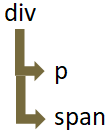
And even though the <div> element has two children.
<p class = "para1"> First Paragraph </p>
<span class = "para2"> Second Paragraph </p>
On button click, the contents of <p> element got changed,
And this happened with the :only-child element selector.
$('button').click( function() {
	$('p:only-of-type').text("The content of the only child of p type got changed")
});
The moment the button is clicked, JQuery statement gets triggered.
$('p:only-of-type').text("The content of the only child of p type got changed")And since, the <p> element is the only child of <p> type (As the other child is of <span> type).
<div class = "newClass1">
	<p class = "para1"> First Paragraph </p>
	<span class = "para2"> Second Paragraph </p>
</div>
$('p:only-of-type') changes the contents of <p> element.